The Indo-European Language Family Tree
Jack Lynch
The chart below shows the relations among some of the languages in the Indo-European family. Though you wouldn't think to look at the tangle of lines and arrows, the chart is very much simplified: many languages and even whole language families are left out. Use it, therefore, with caution. The coverage is most thorough, but still far from complete, in the Germanic branch, which includes English.
The dotted line from French to Middle English suggests not direct descent, but the influx of French vocabulary in the centuries after the Norman Invasion.
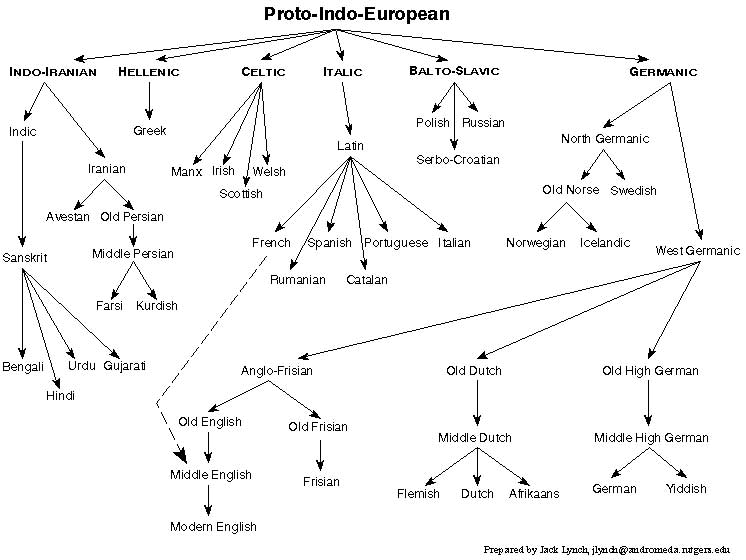
Some caveats. In the interest of making this readable, I've left out dozens of languages. I've even omitted the entire Anatolian, Albanian, and Tocharian families; I've included no languages from the Baltic branch or the Continental Celtic branch; I've grossly oversimplified the Indo-Iranian family; and so on. The historical phases of some languages — Old Swedish, Middle Swedish, Modern Swedish; Vedic Sanskrit, Middle Indic — have been left out. I've made no attempt to distinguish living languages from dead ones. I'm not trying to make the definitive statement of the relationships among all the Indo-European languages, only to give my students some idea of the origins of the English language, and its relations to other familiar languages — along with a few less familiar ones.